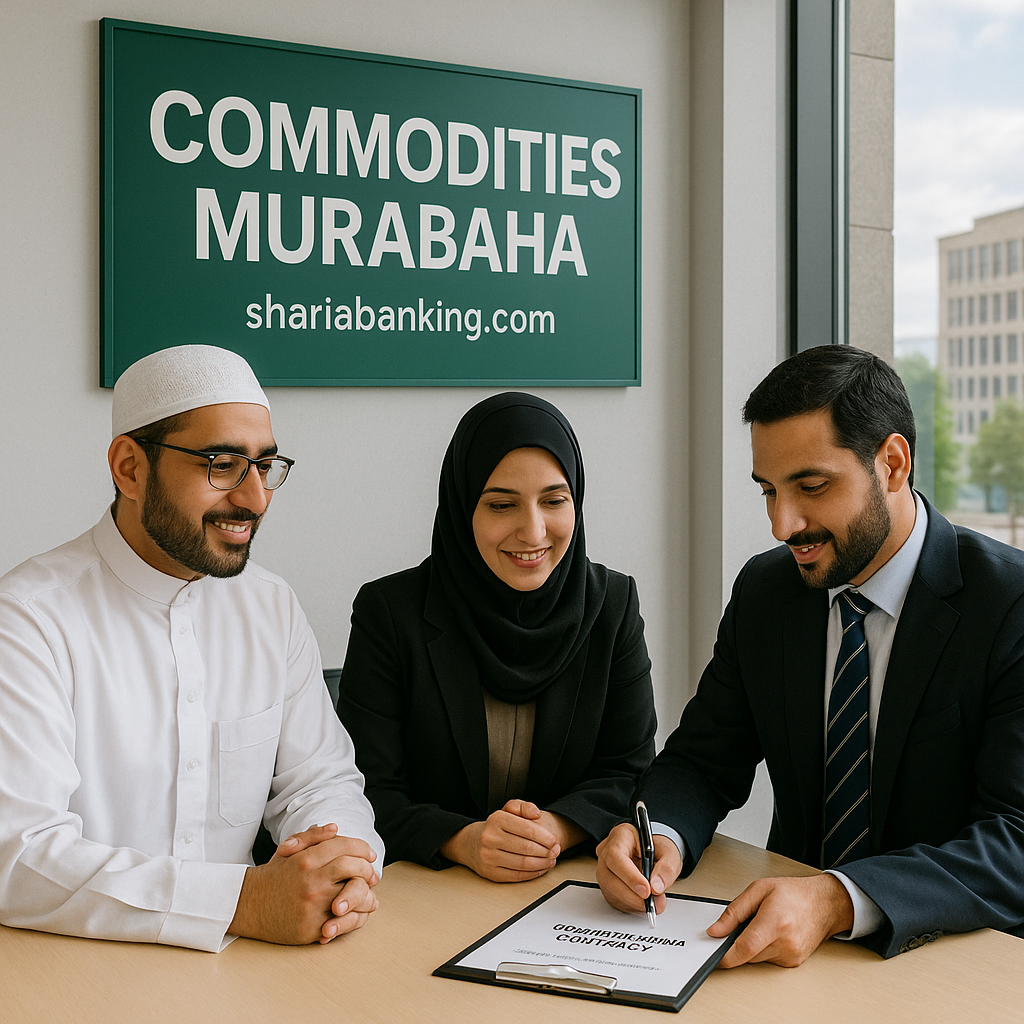
What is the definition of commodities Murabaha)
Commodity Murabaha (often called “tawarruq”) is by definition a Shariah-compliant way to create cash financing or a fixed-profit investment by routing the transaction through a real, tradeable commodity instead of an interest-bearing loan.
In commodity Murabaha, banks use widely traded commodities (e.g., metals) to ensure there is a genuine purchase and sale: the economic aim (cash today, pay more later) is achieved through trade, not lending with interest.
For financing, the typical steps are: (1) the bank buys a commodity spot from Broker A and takes title/possession (often constructively, via warehouse certificates); (2) the bank sells that commodity to the business on deferred murabaha terms at cost + disclosed profit; (3) the business immediately sells the commodity spot to Broker B (or appoints the bank as its agent to do so) and receives cash; (4) the business repays the bank the deferred price in instalments.
<!—wp:paragraph –>
Businesses value commodity murabaha because it delivers predictable, invoice-like cashflows for working capital and deposits, scales from short tenors (1–12 months) to multi-year, and can price off familiar benchmarks (e.g., SONIA/SOFR + a fixed profit, embedded into the sale price) while staying interest-free in form and substance.
What type of commodities murabaha are available ?
Here’s a practical map of the main types of commodity murabaha (tawarruq) you’ll see in the market—grouped by purpose, execution, and structure.
By purpose:
Financing (tawarruq) = borrower gets cash now, repays a fixed murabaha price over time.
Investment (“reverse” murabaha) = depositor places cash, earns fixed profit at maturity.
By execution:
Exchange/platform (warehouse receipts, strong audit trail) or OTC brokers (flexible sizes/timing). Usually constructive possession; physical delivery optional.
By structure:
Agency (wakālah) vs principal-to-principal trading; single fixed term vs rolling short murabahas (to mirror SONIA/SOFR resets); classical vs organized workflows (always avoid buy-back from same counterparty).
By use case:
Working capital, trade/invoice settlement, term funding (capex), interbank/treasury placements.
By commodity:
Widely traded base metals/softs with clear title docs; generally avoid gold/silver (ṣarf rules). Key test: real ownership & risk transfer.
By governance rigor:
Standard pack (agency + promise + murabaha + confirms) vs enhanced controls (dual brokers, strict cut-offs, extra audit trails).
Where can I obtain a commodities murabaha facility for my business ?
Here’s a country-by-country list of banks and institutions that provide Commodity Murabaha facilities:
United Arab Emirates (UAE)
-
- Ajman Bank
-
- Sharjah Islamic Bank (SIB) – in cooperation with DMCC Tradeflow
-
- First Abu Dhabi Bank (FAB)
-
- Dubai Islamic Bank
-
- Abu Dhabi Islamic Bank (ADIB)
Saudi Arabia
-
- Al Rajhi Bank
-
- Bank AlJazira
-
- Saudi National Bank (SNB, Islamic division)
Qatar
-
- Qatar Islamic Bank (QIB)
-
- Masraf Al Rayan
-
- Qatar International Islamic Bank (QIIB)
Kuwait
-
- Kuwait Finance House (KFH)
-
- Boubyan Bank
Bahrain
-
- Al Baraka Banking Group
-
- Ithmaar Bank
Oman
-
- Bank Nizwa
-
- Alizz Islamic Bank
Malaysia
-
- Maybank Islamic
-
- CIMB Islamic
-
- Bank Islam Malaysia
-
- RHB Islamic
Turkey
-
- Kuveyt Türk Participation Bank
-
- Albaraka Türk
-
- Türkiye Finans
Pakistan
-
- Meezan Bank
-
- Bank Islami Pakistan
-
- Dubai Islamic Bank Pakistan
United Kingdom
-
- Al Rayan Bank
-
- QNB London (Qatar National Bank)
-
- Abu Dhabi Islamic Bank UK (corporate desk)
-
- Gatehouse Bank
Kazakhstan
-
- ADCB Kazakhstan (Abu Dhabi Commercial Bank)
Africa
-
- Nigeria: Jaiz Bank
-
- Kenya: Gulf African Bank, First Community Bank
-
- Tunisia: Banque Zitouna
-
- Côte d’Ivoire & Pan-Africa: Africa Finance Corporation (AFC – commodity Murabaha facilities for infrastructure)
Islamic finance concepts and tools
Understand the key contracts and concepts used in halal banking, from Murabaha and Ijara to Qardh ul Hasan and Islamic loan calculation.